Live state
See whether the tape still supports the trade idea.
Regime, pressure, and structural context appear in one operating view instead of scattered indicators.
QuantGrid delivers market-structure metrics across 3,500+ US listed equities and ETFs, with especially strong workflows for index traders.
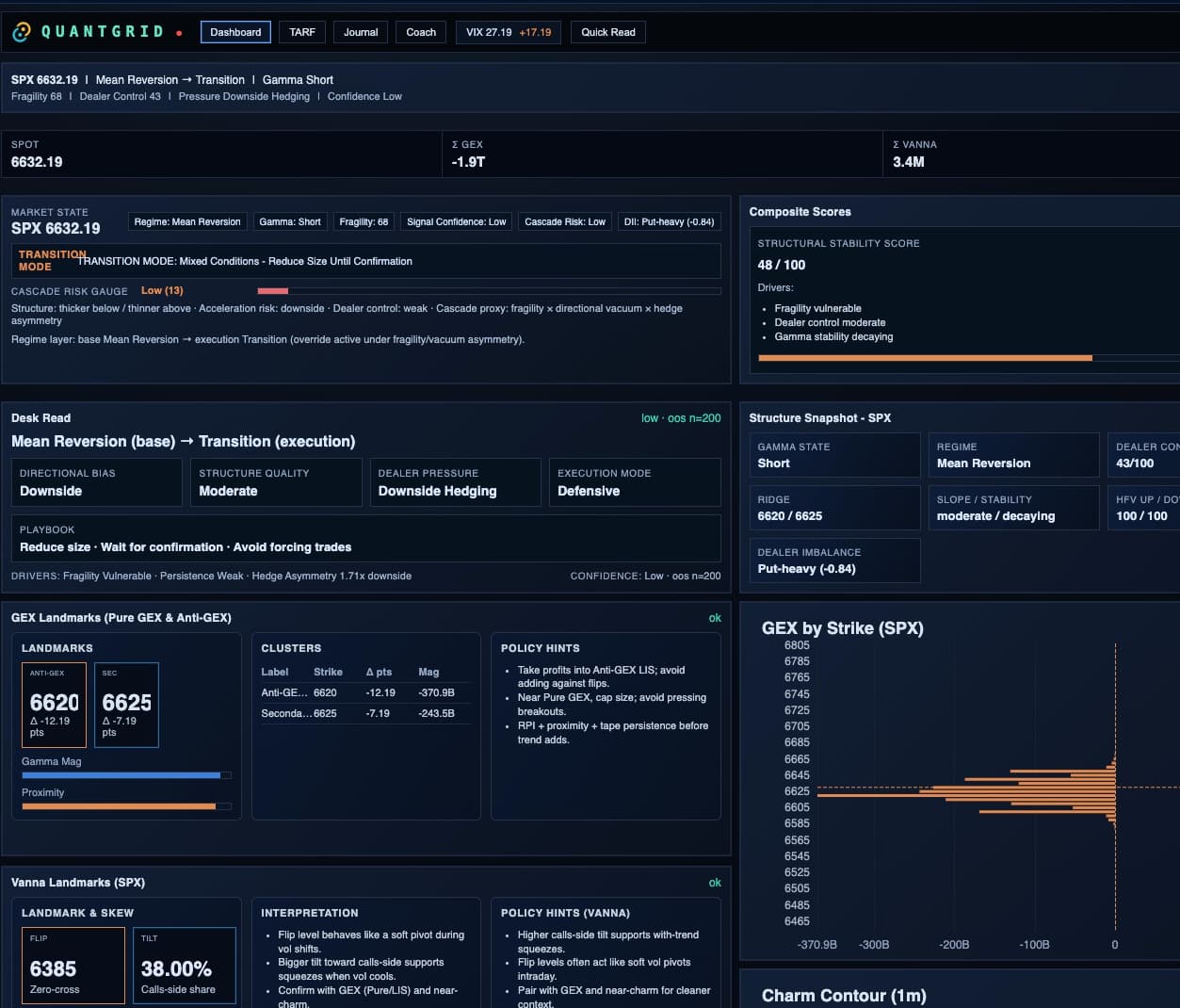
Regime detection / dealer pressure / structural levels / execution posture
02. Terminal view
structure over noise
[© quantgrid - 2026]
proof callout
During a short-gamma transition session, QuantGrid highlighted weakening control and higher vacuum risk before the market moved into directional expansion.
Live state
Regime, pressure, and structural context appear in one operating view instead of scattered indicators.
Execution filter
QuantGrid highlights when dealer control is deteriorating and when expansion risk starts to dominate the session.
Desk use
The terminal is built to inform posture, not generate retail-style signal alerts.
03. Session case study
March 12 / expansion session
QuantGrid identified a transition from balanced rotation into a more fragile state, with weakening control and higher odds of directional expansion.
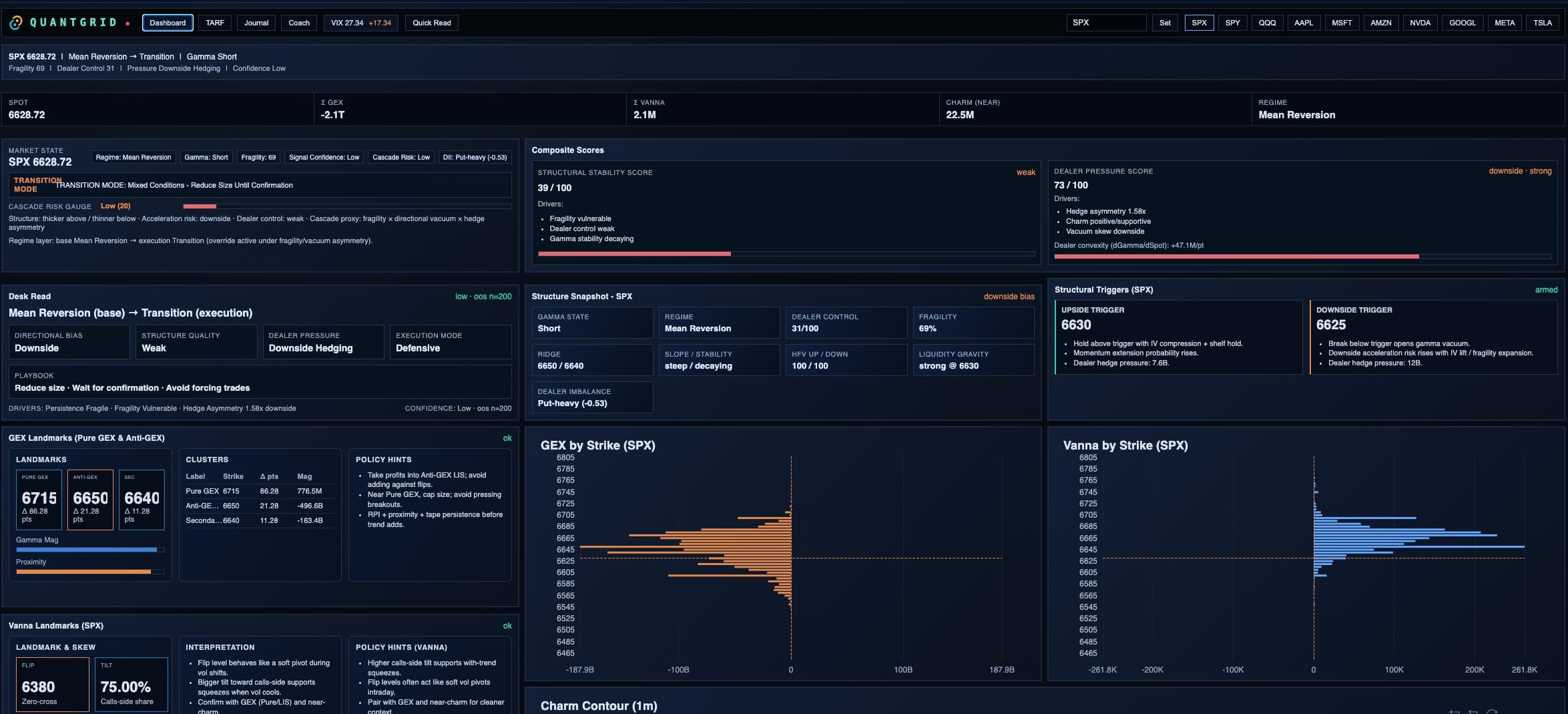
Illustrative market interpretation only. Not investment advice, not a recommendation to trade, and not a representation of future results.
Regime
Rotation quality weakened as the session moved out of balanced conditions.
Dealer control
Supportive control was no longer holding the same fade reliability.
Pressure
The terminal framed a higher probability of fast directional extension.
Execution implication
The better posture was lower fade confidence, wider risk tolerance, or standing aside.
04. How traders use it
01
Map structural levels, likely pressure zones, and the conditions that would invalidate the opening plan.
02
Watch for regime shifts, weakening dealer control, and acceleration risk before committing more risk to a trade idea.
03
Replay difficult sessions, compare the live read to actual market behavior, and refine the framework over time.
05. System architecture
QuantGrid compresses derivatives complexity into a sequence traders can act on: diagnose state, map levels, interpret pressure, and set posture.
building traders with structural edge
[© quantgrid - 2026]
Options positioning, shelf density, and hedging pressure are normalized into a market structure model.
QuantGrid classifies whether the session favors rotation, transition, compression, or expansion risk.
Pure GEX, shelves, call walls, put shelves, and acceleration zones are arranged into one usable stack.
The system translates structure into practical implications: press, fade, reduce size, or step aside.
06. Research basis
Why now
Dealer hedging, liquidity vacuums, and rapid regime transitions now matter more than static support and resistance heuristics.
Research basis
QuantGrid focuses on how positioning, liquidity, and pressure interact during difficult index sessions rather than isolated indicator signals.
Methodology
The platform is designed to improve posture, timing, and trade selection by making structural context visible before risk is committed.
07. Access QuantGrid
QuantGrid is built for discretionary index traders who want better structure before they commit risk.